American Traditional vs. Neo-Traditional Tattoos: Understanding the Key Differences
A tattoo can tell a story through its subject matter, but the artistic style determines how that story looks on your skin. When comparing American traditional vs. neo-traditional tattoos, understanding their visual differences can help you find an approach that complements your personality, design preferences, and long-term expectations.
Both styles share a recognizable foundation of bold outlines, expressive imagery, and intentional composition. However, their approaches to color, shading, detail, and artistic interpretation create noticeably different results.
Think of American traditional tattooing as a classic illustration that communicates its message through strong shapes and unmistakable symbols. Neo-traditional tattooing takes that familiar visual language and expands it with additional dimension, decorative elements, and creative flexibility.
Neither style needs to imitate the other to produce compelling artwork. The most meaningful distinction lies in understanding what each approach can communicate and how its characteristics translate into a permanent design.
What Are American Traditional Tattoos?
American traditional tattoos, sometimes called old school tattoos, are recognized by their heavy black outlines, compact color palettes, and simplified imagery. Their straightforward appearance makes them easy to identify, even among an extensive collection of different tattoo styles.
Traditional designs often feature recognizable subjects such as roses, swallows, daggers, ships, hearts, and eagles. Rather than reproducing every realistic detail, artists emphasize the essential characteristics that make each subject immediately understandable.
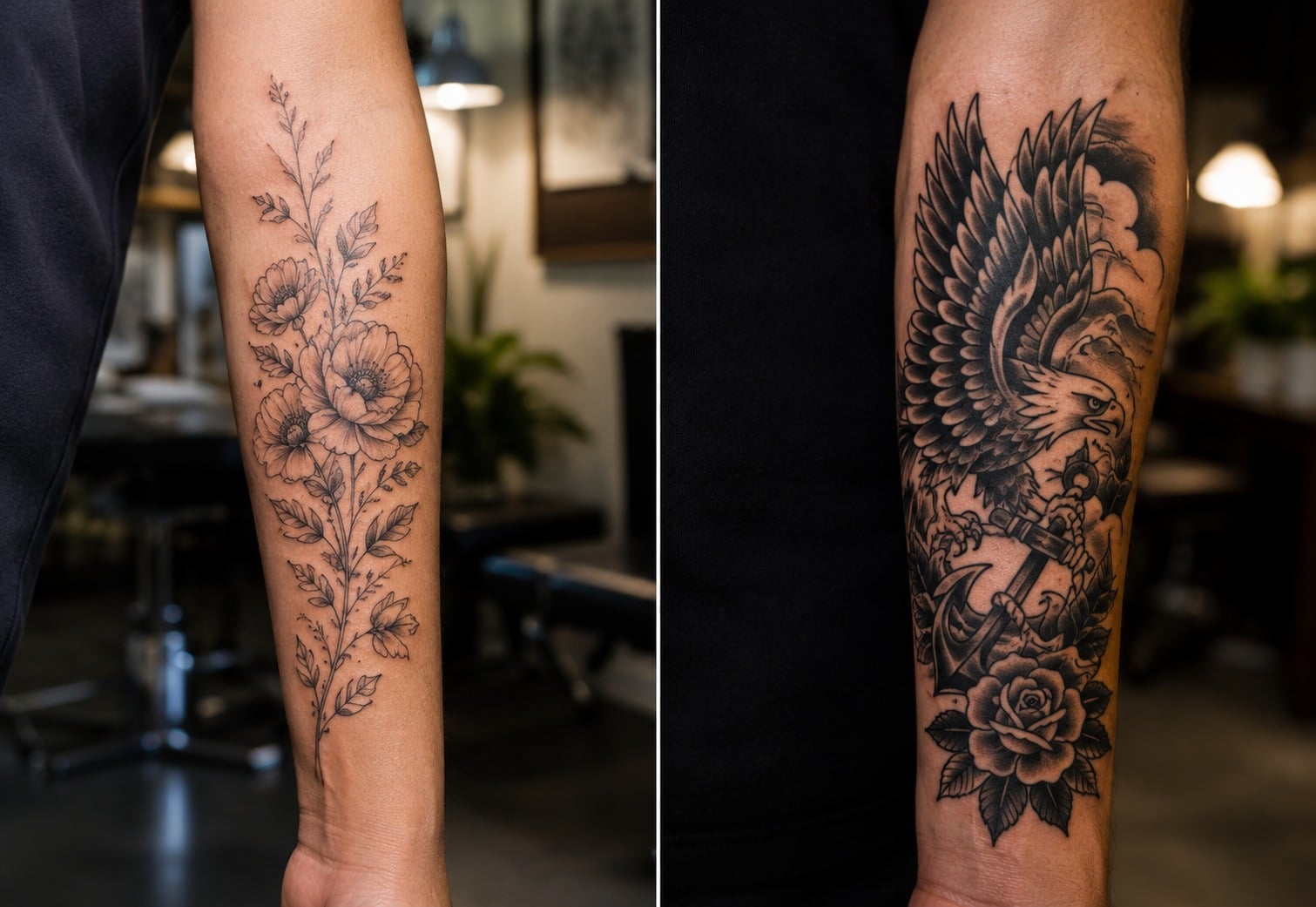
An American traditional eagle, for example, might feature broad wings, defined feathers, and contrasting areas of black, red, and yellow. The purpose is not to create a photographic depiction but to communicate the strength and movement of the bird through a bold graphic composition.
The defining characteristics of American traditional tattooing
Several artistic principles distinguish traditional tattoos from other forms of body art. These include strong outlines, controlled color choices, relatively simple shading, and an emphasis on recognizable shapes.
A traditional tattoo often resembles artwork printed on a vintage poster or classic tattoo flash sheet. Its design relies on contrast and structure rather than an abundance of tiny details.
Artists also pay close attention to the relationship between individual elements and the negative space surrounding them. This helps maintain visual clarity and allows the main subject to remain recognizable without requiring excessive decorative elements.
Why traditional tattoos remain recognizable
Trends in body art change, but the visual identity of traditional tattooing has remained remarkably consistent. Its established artistic conventions create a recognizable connection between contemporary designs and the historical practices that influenced them.
This does not mean every traditional tattoo must look identical or reproduce historical artwork. Artists can reinterpret established motifs while preserving the bold outlines, simplified shapes, and restrained visual structure associated with the style.
What Are Neo-Traditional Tattoos?
Neo-traditional tattoos developed from the artistic foundations established by traditional tattooing while introducing additional visual complexity. They retain prominent outlines and readable compositions but allow artists to incorporate expanded color palettes, layered shading, and more decorative imagery.
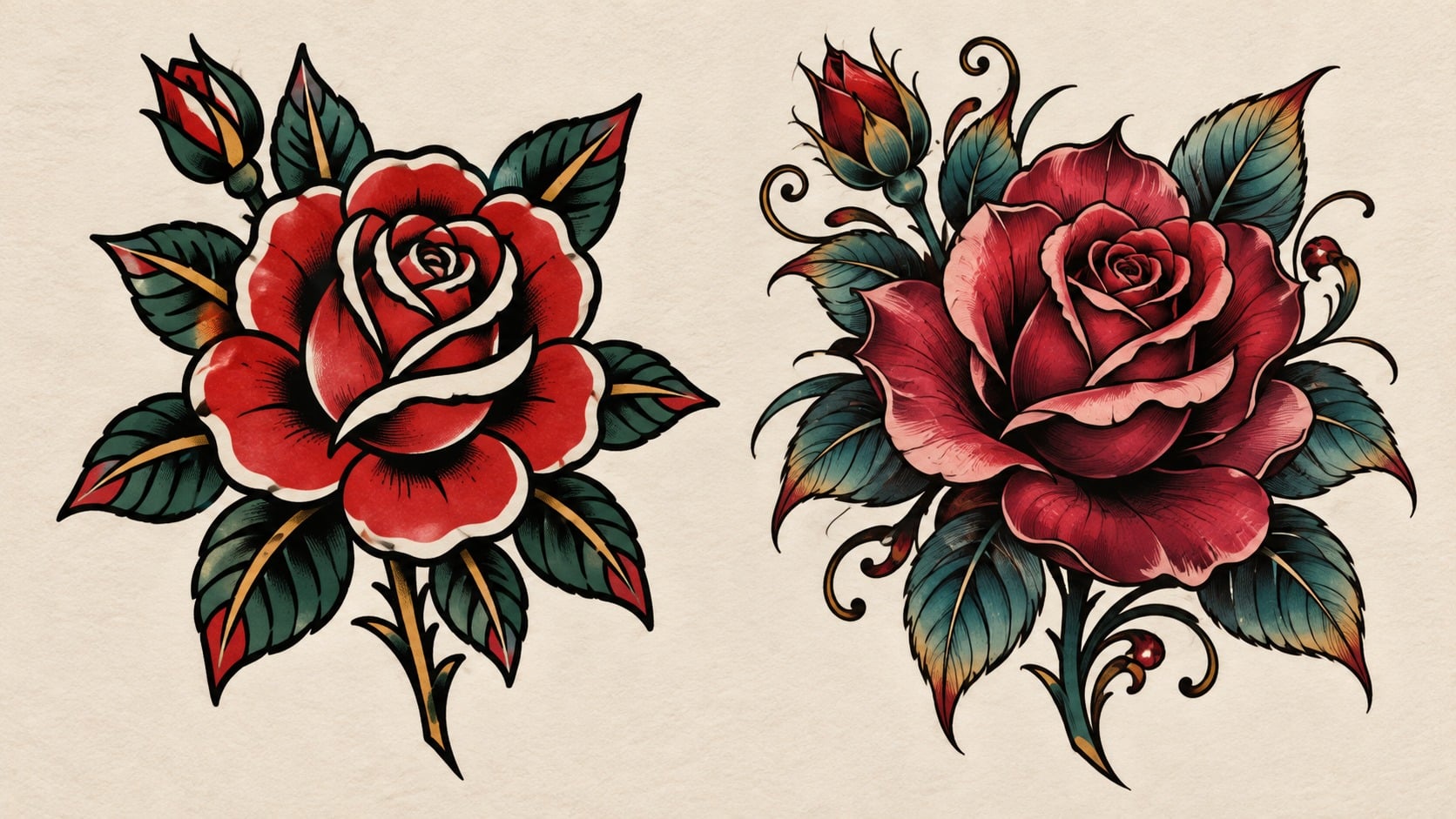
Where a traditional tattoo might portray a rose using several solid blocks of color, a neo-traditional rose may feature multiple tones within individual petals. Carefully placed highlights and shadows create the impression of depth without requiring a completely realistic appearance.
Neo-traditional artwork frequently incorporates influences from illustration, Art Nouveau, Art Deco, and other decorative traditions. These influences can appear through flowing botanical forms, ornamental framing, stylized portraiture, and intricate background elements.
The defining characteristics of neo-traditional tattooing
A neo-traditional tattoo typically combines bold exterior outlines with thinner interior lines that define smaller features. This variation introduces a visual hierarchy, directing attention toward important parts of the design while preserving its overall structure.
Color choices can also be significantly more expansive than those associated with traditional tattoos. Artists may incorporate jewel tones, muted colors, layered transitions, and complementary shades to establish atmosphere and dimension.
Neo-traditional designs commonly feature detailed animals, elaborate flowers, stylized human portraits, and imaginative subjects. Their artistic flexibility makes them particularly suitable for compositions that combine several visual elements into one cohesive piece.
Why neo-traditional tattoos feel more illustrative
Neo-traditional tattooing often resembles the kind of artwork you might discover in an illustrated storybook or a detailed botanical print. Its subjects can appear dimensional and expressive without following the strict visual rules associated with photorealism.
An artist might exaggerate a fox’s facial features, incorporate decorative foliage, and create movement through curved lines. Although the finished piece remains recognizable as a tattoo illustration, its additional details give the subject a distinct artistic personality.
American Traditional vs. Neo-Traditional Tattoos: The Main Differences
Although these tattoo styles share historical roots, their differences become clearer when comparing individual design elements. Linework, color selection, shading, complexity, and overall composition all contribute to their distinctive appearances.
| Design feature | American traditional | Neo-traditional |
|---|---|---|
| Outlines | Bold, generally consistent | Bold exterior lines with varied interior weights |
| Colors | Limited, saturated palette | Expanded palette with more tonal variation |
| Shading | Simplified black shading and solid fills | Layered shading and dimensional transitions |
| Detail | Deliberately simplified | More intricate and illustrative |
| Common subjects | Eagles, anchors, roses, daggers | Ornate animals, portraits, flowers, fantasy imagery |
| Composition | Graphic and direct | Decorative and often more elaborate |
| Overall appearance | Classic tattoo flash | Detailed illustrative artwork |
1. Linework and outlining techniques
Traditional tattoos generally use substantial black outlines that clearly separate individual parts of a composition. Consistent line weight gives the artwork a cohesive appearance and establishes the structure of the design.
Neo-traditional tattoos preserve strong outlines but frequently introduce noticeable variations in thickness. An artist may use a heavy outer contour around an animal’s silhouette while applying thinner lines to its facial features, fur, or surrounding flowers.
This difference affects how the eye moves across the finished artwork. Traditional lines emphasize the subject’s overall shape, while neo-traditional lines can guide attention toward individual areas of detail.
2. Color palettes and visual intensity
American traditional tattoos historically favor a relatively limited selection of colors, including red, yellow, green, blue, and black. Artists often use those colors in solid, contrasting sections that reinforce the shapes within the design.
Neo-traditional tattoos can feature deeper purples, turquoise, burgundy, muted greens, and other colors that expand the artistic possibilities. Rather than separating every shade into a distinct block, artists may blend neighboring tones to establish smoother transitions.
Consider a classic red rose surrounded by dark green leaves and strong black outlines. A neo-traditional interpretation might introduce burgundy shadows, pink highlights, teal foliage, and subtle color variations within the petals.
3. Shading and dimensional effects
Shading is another important difference between American traditional and neo-traditional tattoos. Traditional artwork typically uses simplified areas of black shading to communicate shape while preserving a relatively flat graphic appearance.
Neo-traditional artists may use multiple layers of shading to establish rounded forms, recessed areas, and directional lighting. This allows a flower to appear more dimensional or an animal’s face to display greater visual depth.
However, dimensional shading does not automatically make a tattoo neo-traditional. Its classification also depends on the overall composition, linework, colors, and artistic influences.
4. Detail and design complexity
Traditional tattooing emphasizes restraint, meaning artists remove unnecessary details that could distract from the main subject. A carefully simplified design can communicate movement, emotion, and symbolism without relying on elaborate textures.
Neo-traditional tattooing offers additional space for ornamental features, layered backgrounds, and intricate internal structures. Decorative leaves, patterned fabrics, small highlights, and carefully arranged secondary subjects can all contribute to the overall composition.
The challenge is maintaining balance between detail and readability. An overly crowded design may become difficult to distinguish regardless of which artistic category it belongs to.
5. Artistic expression and overall appearance
Traditional tattoo designs often create an immediate impression through their straightforward shapes and saturated colors. Their aesthetic reflects a recognizable visual heritage that connects contemporary tattooing with earlier generations of artists.
Neo-traditional tattoos allow artists to develop more elaborate interpretations while retaining elements of that established tradition. Their expressive possibilities can accommodate unusual color combinations, decorative arrangements, and highly personalized subject matter.
Ultimately, the distinction is not about the amount of effort required to create either style. Both demand strong drawing skills, thoughtful composition, technical knowledge, and an understanding of how artwork translates onto skin.
Understanding the History Behind Both Styles
American traditional tattooing developed through several generations of Western tattoo culture, drawing heavily from maritime traditions, military communities, and early commercial tattoo shops. Artists such as Norman “Sailor Jerry” Collins, Bert Grimm, and other influential tattooers helped establish the recognizable imagery associated with the style.
Classic tattoo flash provided customers with ready-made designs featuring familiar symbols and striking compositions. These illustrations helped establish an artistic vocabulary that continues to influence tattooing today.
Neo-traditional tattooing emerged much later as artists expanded upon those established visual conventions. Its development reflects broader experimentation with illustration, color, decorative art, and increasingly varied tattoo techniques.
Unlike traditional designs that frequently draw from established flash imagery, neo-traditional artwork can incorporate a wider range of contemporary artistic influences. However, both approaches continue evolving as individual artists introduce their own interpretations.
The historical relationship explains why the two styles sometimes appear remarkably similar. Neo-traditional tattooing did not abandon the foundations of traditional tattooing; it expanded the possibilities built upon them.
Popular American Traditional Tattoo Designs
Traditional tattoo imagery frequently carries symbolic associations that extend beyond its striking appearance. Although interpretations vary among individuals and cultures, certain motifs have maintained recognizable connections to historical tattoo practices.
Eagles, panthers, and other animals
Eagles are commonly associated with strength, freedom, and patriotic imagery within American tattoo culture. Their broad wings and recognizable silhouettes translate naturally into the bold compositions associated with traditional tattooing.
Panthers are another established subject, frequently depicted with curved bodies, extended claws, and exaggerated expressions. The simplified anatomy and substantial areas of black ink create a dramatic design without requiring photorealistic detail.
Swallows, snakes, and wolves also appear throughout traditional tattoo artwork. Each animal can be adapted into different compositions while maintaining the graphic simplicity characteristic of the style.
Roses, daggers, and symbolic imagery
Roses remain among the most recognizable subjects in American traditional tattooing. Their layered petals and contrasting leaves provide opportunities for strong color placement without introducing excessive visual complexity.
Daggers, hearts, anchors, and ships are equally prominent within classic tattoo imagery. These subjects can stand alone or appear together in carefully balanced compositions.
A dagger piercing a rose, for example, may suggest contrasting ideas such as beauty and danger. Its personal significance ultimately depends on the individual wearing the tattoo rather than any universally fixed interpretation.
Popular Neo-Traditional Tattoo Designs
Neo-traditional tattoo designs frequently reinterpret familiar subjects through more elaborate illustration and decorative composition. The additional artistic freedom allows artists to explore detailed imagery while preserving recognizable shapes.
Decorative animal portraits
Animals are particularly popular subjects because neo-traditional techniques can emphasize facial expressions, patterned markings, and distinctive anatomical features. Foxes, owls, wolves, tigers, and other animals can become expressive illustrations surrounded by complementary decorative elements.
An owl tattoo might feature carefully shaded feathers, jewel-toned eyes, and ornamental foliage framing its face. The finished image can feel sophisticated and detailed without attempting to reproduce a photograph.
Botanical compositions and ornamental flowers
Flowers provide an excellent foundation for neo-traditional artwork because their natural forms accommodate flowing lines and layered colors. Peonies, chrysanthemums, roses, and other botanical subjects can be developed into elaborate arrangements.
Artists may emphasize individual petals through carefully placed shadows and contrasting highlights. Decorative leaves, flowing stems, and complementary background shapes can connect separate elements into one composition.
Portraits, mythology, and imaginative subjects
Neo-traditional tattooing also accommodates stylized portraits and imagery drawn from mythology, literature, and fantasy. An artist might create an elaborate interpretation of a mythological figure using ornamental framing, expressive facial features, and symbolic details.
Unlike realism, which generally emphasizes lifelike representation, neo-traditional portraiture can intentionally exaggerate certain characteristics. This allows the artwork to communicate a specific mood while retaining its illustrative identity.
How the Same Tattoo Concept Changes Between Styles
One of the easiest ways to understand the difference between traditional and neo-traditional tattoos is to imagine the same subject interpreted through both approaches. Although the underlying concept remains unchanged, the artistic decisions produce distinctly different results.
Example 1: A rose tattoo
An American traditional rose might feature thick black outlines, solid red petals, dark green leaves, and limited black shading. Its composition would emphasize the flower’s recognizable silhouette and established tattoo imagery.
A neo-traditional rose might include several shades of red, subtle highlights, layered petals, and more detailed foliage. Additional decorative elements could help create a softer or more dramatic atmosphere.
Example 2: A wolf tattoo
A traditional wolf design might depict a powerful head with simplified fur, prominent teeth, and substantial areas of black shading. The artwork would communicate the animal’s expression through strong, immediately recognizable shapes.
A neo-traditional wolf could feature varied fur textures, contrasting highlights, ornamental flowers, and more complex color transitions. Its composition might also incorporate decorative framing to establish a particular visual mood.
Example 3: A dagger tattoo
A traditional dagger generally features a clear silhouette, symmetrical elements, and simplified metallic details. The blade may be surrounded by a banner, flower, or heart without overwhelming the central subject.
A neo-traditional dagger might include an intricately illustrated handle, ornamental metalwork, gemstones, and more dimensional shading. These additional elements allow the artist to create a richer interpretation of the same familiar motif.
Which Tattoo Style Offers More Design Flexibility?
Both styles accommodate customization, although they approach creative freedom differently. Traditional tattooing encourages artists to explore established imagery within a recognizable set of artistic conventions.
A custom American traditional tattoo can incorporate personal symbols, meaningful combinations, and original arrangements without abandoning the style’s visual identity. Its creativity often emerges from how familiar elements are simplified and composed.
Neo-traditional tattooing generally allows greater variation in decorative detail, color transitions, and illustrative complexity. This flexibility can be especially useful when the subject includes multiple textures, unusual objects, or elaborate visual storytelling.
However, additional flexibility also introduces decisions about composition, scale, and readability. Every decorative element should contribute to the artwork rather than simply occupy available space.
Tattoo Placement and Size Considerations
Tattoo placement affects how an illustration interacts with the natural curves and movement of the body. Whether you prefer American traditional or neo-traditional artwork, the design should account for the shape and dimensions of the intended location.
Placement for American traditional tattoos
Traditional tattoos frequently work well as standalone compositions because their recognizable silhouettes create visual separation from surrounding artwork. Upper arms, forearms, calves, shoulders, and thighs can accommodate many classic designs.
For instance, a traditional eagle might fit naturally across a broad shoulder, while a vertically arranged dagger could complement the shape of a forearm. The final dimensions should allow sufficient room for the outlines, shading, and negative space.
Traditional designs can also work within patchwork tattoo collections featuring several independent subjects. Their established visual conventions often create cohesion even when the surrounding tattoos depict unrelated imagery.
Placement for neo-traditional tattoos
Neo-traditional designs often benefit from areas that provide enough space for decorative details and layered shading. Thighs, upper arms, backs, and larger forearm sections can accommodate compositions with multiple subjects or elaborate framing.
A detailed animal portrait surrounded by flowers may need a larger area than a simplified traditional animal design. Reducing its size excessively could compromise smaller features and the separation between adjacent lines.
Body movement is another consideration, especially when a composition crosses joints or wraps around curved surfaces. An artist can adapt the orientation and arrangement to accommodate the intended placement.
Does tattoo size affect visual clarity?
Tattoo size is important because every line and shaded area occupies physical space within the skin. Details that appear clearly separated in a large digital illustration may become crowded when reproduced at a significantly smaller scale.
This is particularly relevant for neo-traditional designs containing numerous fine interior lines. Simplifying decorative elements or increasing the dimensions can help preserve recognizable shapes.
Traditional tattoos also require sufficient spacing, despite their relatively simplified appearance. Bold outlines placed too closely together may gradually lose their separation as the tattoo changes over time.
How Do Traditional and Neo-Traditional Tattoos Age?
Both styles can maintain recognizable compositions for many years when they are appropriately designed, applied, and cared for. However, no tattoo remains completely unchanged because skin, pigments, and environmental exposure all influence its appearance.
How American traditional tattoos age
Traditional designs often emphasize strong black outlines, substantial contrast, and relatively simple shapes. These characteristics can help preserve the overall readability of an illustration as smaller details naturally soften.
For example, a traditional anchor may remain recognizable even when its once-crisp edges become less distinct. The strength of its silhouette helps communicate the subject without depending on tiny interior details.
However, this does not mean traditional tattoos are immune to fading or changes in line definition. Placement, application, skin characteristics, and long-term exposure can still influence their appearance.
How neo-traditional tattoos age
Neo-traditional tattoos also use strong structural outlines, which can support long-term readability. However, designs containing numerous fine details or subtle color transitions may experience noticeable changes in those smaller visual elements.
An elaborate floral arrangement might retain its primary shapes while delicate petal textures become less prominent. Thoughtful spacing, contrast, and overall composition can help maintain a clear visual hierarchy.
The relationship between detail and size is especially important when planning these designs. A larger composition can provide additional room for complex elements without requiring every feature to sit closely beside another.
The role of sunlight and skin care
Sun exposure can affect the appearance of tattoo pigments regardless of artistic style. The American Academy of Dermatology explains that ultraviolet radiation can fade some tattoo inks and recommends protecting healed tattoos with broad-spectrum, water-resistant sunscreen rated SPF 30 or higher.
Keeping tattooed skin moisturized and following appropriate aftercare instructions also supports skin health. For newly applied tattoos, follow the specific healing guidance provided by your tattoo artist and seek medical attention if signs of infection or an unusual reaction develop.
Understanding Black and Grey Variations
Color is an important characteristic of traditional and neo-traditional tattooing, but it is not the only defining feature. Both approaches can be adapted into compositions emphasizing black ink and grey shading.
A black and grey American traditional tattoo generally preserves bold outlines, simplified shapes, and controlled shading. Its recognizable silhouette remains the primary visual element even without a conventional color palette.
Black and grey neo-traditional artwork may incorporate more complex tonal transitions, decorative textures, and varied line weights. These techniques can introduce dimension while maintaining an illustrative appearance.
The absence of color does not automatically transform either style into realism or blackwork. The underlying drawing principles and composition remain important when identifying the artistic approach.
Common Misconceptions About Both Styles
Understanding these tattoo styles also means recognizing assumptions that do not accurately reflect how artists work. Several misconceptions arise when people focus on individual visual characteristics without considering the complete design.
Misconception 1: Traditional tattoos cannot be customized
Traditional tattooing has established artistic conventions, but those conventions do not prevent original artwork. Artists can create entirely custom compositions while preserving recognizable outlines, colors, and simplified imagery.
A personalized traditional piece might combine several meaningful subjects in a way that has never appeared on a flash sheet. Its classification depends on its visual structure rather than whether the illustration already existed.
Misconception 2: Neo-traditional tattoos are simply more realistic
Neo-traditional artwork often contains greater detail and dimensional shading, but it does not necessarily aim for photographic accuracy. Artists frequently exaggerate proportions, manipulate colors, and incorporate decorative features that deliberately move away from realism.
A neo-traditional portrait may feature stylized eyes, ornamental shapes, and imaginative colors. These elements distinguish its illustrative approach from the visual goals of a photorealistic portrait.
Misconception 3: Traditional tattoos always last longer
The strong outlines and simplified compositions associated with traditional tattooing can support long-term readability. However, it would be misleading to promise that every traditional tattoo will age better than every neo-traditional design.
Application technique, tattoo size, skin characteristics, placement, and ongoing care all influence long-term appearance. A thoughtfully designed neo-traditional piece can remain recognizable for many years, while a poorly executed traditional tattoo may develop noticeable visual problems.
Misconception 4: Neo-traditional means the same thing as new school
Neo-traditional and new school tattoos are distinct artistic categories, although individual designs sometimes borrow characteristics from both. Neo-traditional generally preserves strong connections to traditional tattoo structure and decorative illustration.
New school tattooing more commonly emphasizes exaggerated cartoon-like forms, playful proportions, and vibrant, sometimes graffiti-influenced imagery. Recognizing these differences can make it easier to communicate specific artistic preferences.
How to Identify Each Style in a Tattoo Portfolio
Examining an artist’s portfolio can reveal more about their approach than relying exclusively on style labels. Look for consistency in the types of outlines, shading techniques, compositions, and finished designs they produce.
For American traditional tattoos, pay attention to whether the imagery remains clear when viewed from a distance. Strong silhouettes, intentional negative space, and controlled color placement are useful characteristics to examine.
For neo-traditional tattoos, look at how the artist organizes intricate details without overwhelming the primary subject. Notice whether heavier outlines establish structure and whether the decorative elements complement the overall composition.
Healed examples can provide additional context because fresh photographs do not show how the artwork looks after the initial healing process. When available, comparing fresh and healed pieces can help establish realistic expectations about the finished result.
Choosing a Tattoo Style That Fits Your Vision
The distinction between American traditional vs. neo-traditional tattoos becomes most useful when applied to an actual design concept. Instead of choosing a style based exclusively on popularity, consider the type of visual expression you want your artwork to communicate.
If you appreciate vintage tattoo imagery, simplified illustrations, and recognizable symbols, American traditional conventions may align with your preferences. If you gravitate toward ornate compositions, layered color, and decorative illustration, neo-traditional techniques may provide the flexibility your concept requires.
Consider how your subject will look from several viewing distances and whether it needs elaborate detail to communicate its meaning. The intended placement, dimensions, and surrounding tattoos can also influence the overall composition.
Discussing these characteristics with an artist can clarify which techniques suit your idea. A design does not need to include every recognizable feature of a particular style to reflect its underlying artistic influence.
Final Thoughts
American traditional and neo-traditional tattooing share a rich artistic history, but each expresses that heritage through a different visual approach. Traditional designs emphasize bold simplicity and established imagery, while neo-traditional compositions expand those foundations through layered shading, varied linework, and decorative detail.
Understanding these differences makes it easier to recognize the artistic characteristics that appeal to you and communicate your preferences clearly. Rather than viewing one style as a replacement for the other, consider how their distinct approaches can bring different qualities to the same tattoo concept.
At DH Tattooing in Livermore, California, custom tattoo artwork is central to the studio’s approach, with American traditional and other tattoo styles represented among its services. Exploring the studio’s work can help illustrate how thoughtful design, strong composition, and individual artistic interpretation come together in permanent body art.