How Long Does a Tattoo Take? What to Expect From Small Pieces to Full-Day Sessions
If you’re planning a tattoo, one practical question probably appears pretty quickly: How long does a tattoo take?
The short answer is anywhere from a relatively brief appointment to many hours spread across several sessions.
That’s a big range, but there’s a reason for it. Tattooing isn’t like printing an image onto your skin. An artist has to translate a design onto a living, curved, moving surface while creating clean lines, smooth shading, intentional contrast, and the right level of detail.
A small, straightforward piece may be completed during a shorter appointment. A detailed portrait, large black and grey composition, sleeve, or back piece can become a much larger project requiring multiple appointments.
Size matters, but it is only part of the equation.
Design complexity, tattoo style, placement, shading, skin response, breaks, stencil preparation, and the artist’s process can all influence the tattoo session length.
That means two tattoos that look approximately the same size could require surprisingly different amounts of time.
Understanding why makes it much easier to plan your appointment and to appreciate why a quality tattoo shouldn’t be rushed.
Why Tattoo Time Is Hard to Predict
Imagine asking a painter how long it takes to paint a canvas without showing them what needs to be painted.
A minimalist shape and a photorealistic portrait could occupy the same size canvas, but they clearly wouldn’t require the same amount of work.
Tattooing works in much the same way.
An artist needs to consider several variables before estimating how long your tattoo might take:
- Overall size
- Amount of detail
- Linework
- Shading
- Color or black and grey
- Placement
- Skin characteristics
- Design adjustments
- Stencil placement
- Breaks during the appointment
- How well the skin accepts continued work
- Whether the project is designed for one or multiple sessions
For this reason, tattoo time estimates should be treated as estimates rather than guarantees.
A consultation gives your artist an opportunity to evaluate the actual concept instead of trying to estimate from a vague description.
How Long Do Small Tattoos Take?
Small tattoos are usually on the shorter end of the spectrum, but “small” doesn’t automatically mean “fast.”
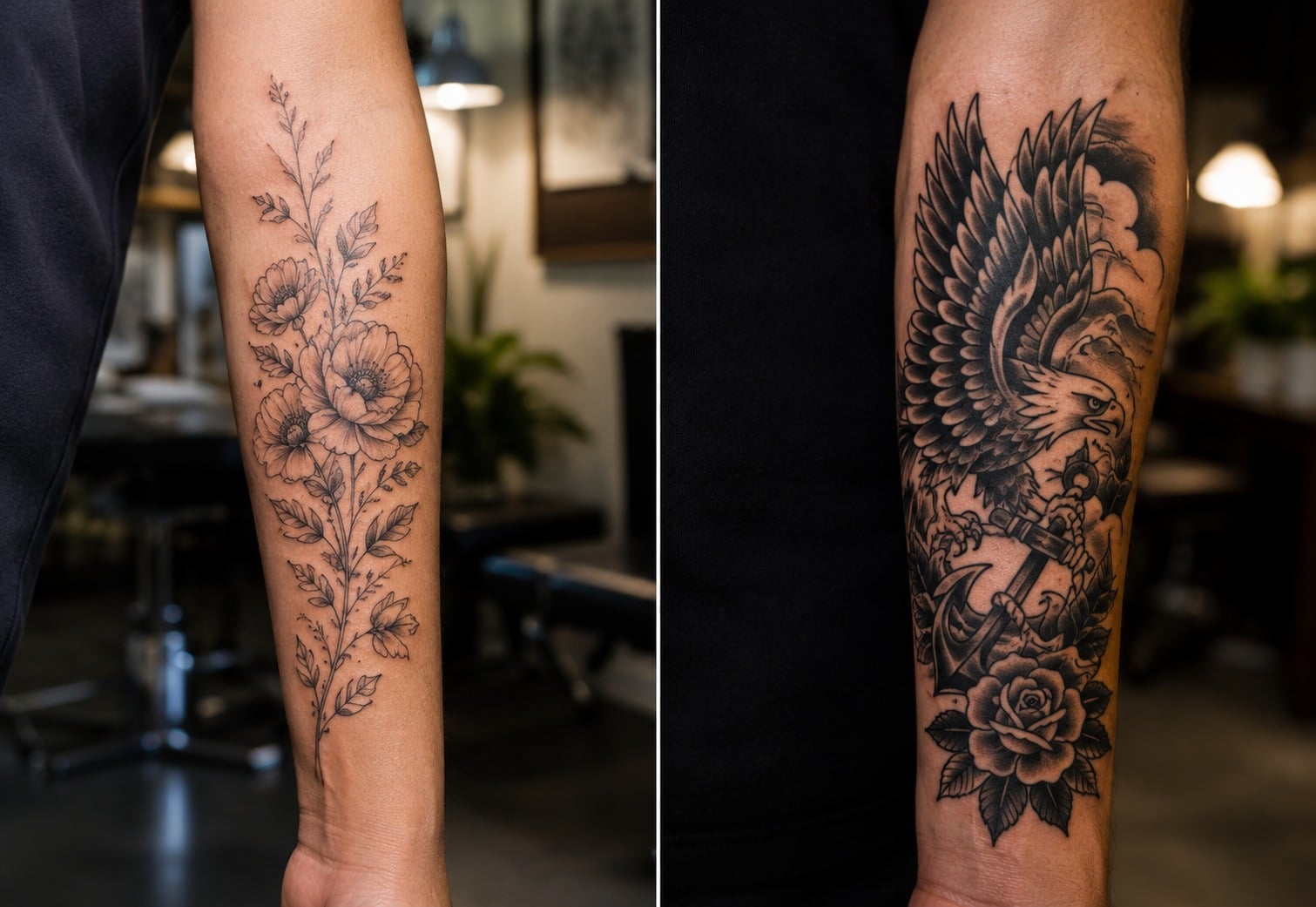
A simple symbol with limited linework can be considerably quicker than a similarly sized piece packed with tiny details, precise geometry, stippling, or realistic shading.
There is also more to the appointment than the time when the machine is actively tattooing.
Your artist may need to finalize the design, prepare the workstation, clean and prepare the skin, size the stencil, apply it, inspect the placement, and potentially reposition it.
That preparation matters.
If a small tattoo takes a relatively short amount of actual tattooing time, the complete appointment can still be longer.
This is especially important for first-time clients who may assume that a small tattoo means walking into a studio and walking out a few minutes later.
Good tattooing involves preparation before the first line is made.
Does a Tiny Tattoo Always Take Less Time?
Usually, but not necessarily in direct proportion to its size.
Tiny designs can demand considerable precision.
A very small design with intricate linework leaves little room for error. Every element has to remain readable at that scale, and the artist may need to simplify or adjust the design so it works effectively as a tattoo.
So while a tiny tattoo generally won’t require the time commitment of a sleeve, its size alone doesn’t tell you exactly how long the appointment will be.
How Long Do Medium Tattoos Take?
Medium tattoos can move into several hours depending on the design.
Think about pieces that occupy a meaningful portion of the forearm, upper arm, calf, thigh, shoulder, or another similar area.
At this size, the amount of detail becomes increasingly important.
A medium tattoo composed primarily of clean outlines may progress relatively quickly compared with a detailed black and grey piece of the same dimensions. Once an artist starts building gradients, texture, depth, highlights, and fine details, the time requirement can grow significantly.
The shape of the body also begins to matter more.
A tattoo doesn’t exist on a flat sheet of paper. The artist has to make the composition work across muscle, bone, curves, and natural movement.
That can require careful positioning throughout the session.
How Long Do Large Tattoos Take?
Large tattoos can require long appointments or multiple sessions.
A large piece may cover much of the upper arm, thigh, chest, ribs, back, or another broad area. At this scale, tattooing becomes less like completing an isolated image and more like constructing a full composition.
The artist may need to establish:
- Major outlines
- Structural elements
- Dark values
- Midtones
- Smooth shading
- Fine textures
- Background elements
- Transitions between different areas
Trying to complete every element simply because the clock says there are hours left isn’t always the best approach.
Skin changes as it is tattooed. It can become irritated and swollen, and there may come a point when stopping and allowing the area to recover is preferable to continuing.
Large tattoos therefore often become projects rather than single appointments.
How Long Does a Sleeve Tattoo Take?
A sleeve is one of the clearest examples of why the question “how long does a tattoo take?” doesn’t always have a one-day answer.
A full sleeve covers a large, three-dimensional area. It also has to look cohesive from multiple angles.
That means the artist isn’t simply filling a rectangle from top to bottom. The design needs to flow around the arm, account for joints and muscle structure, connect major elements, and remain visually balanced when viewed from different directions.
Complex sleeves commonly require multiple tattoo sessions.
The exact number varies significantly based on the style and design.
A sleeve featuring large areas of solid black has different technical demands from a sleeve built around highly rendered black and grey realism. A composition featuring portraits, animals, architecture, smoke, textures, or intricate backgrounds may require extensive layering and detail.
Clients planning a sleeve should think in terms of a project timeline rather than looking for one universal number of hours.
What Actually Happens During a Tattoo Appointment?
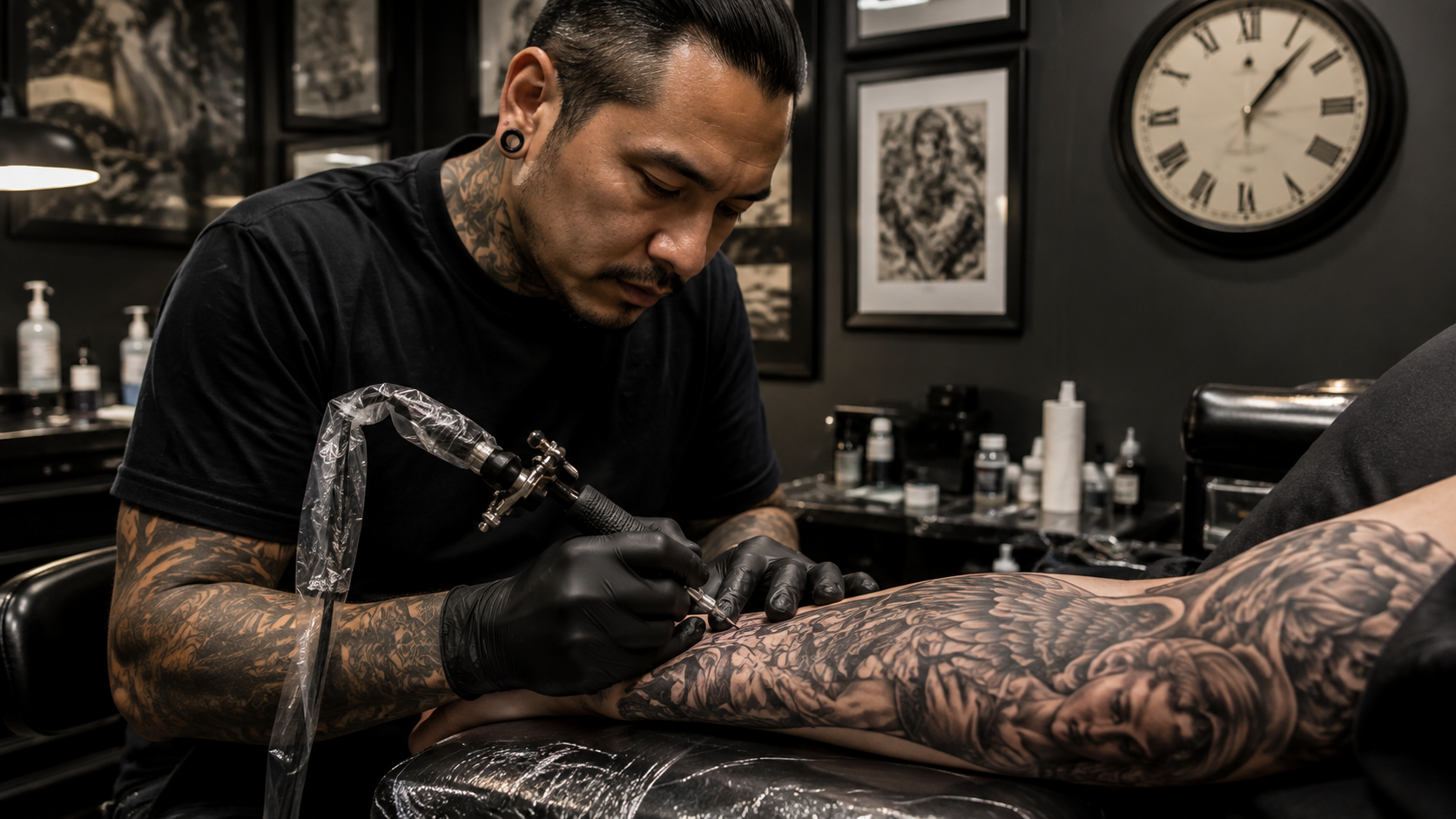
One of the biggest misconceptions about tattoo duration is that every minute of the appointment is spent under the needle.
It isn’t.
Depending on the project and studio process, your appointment can include several stages.
First comes preparation.
The artist needs a clean, organized workspace and the appropriate supplies. Your skin also has to be prepared.
Then comes final placement.
The stencil may need to be positioned and inspected. You may look at it in a mirror and evaluate how it sits naturally on your body.
Once everyone is satisfied, tattooing can begin.
During the tattoo itself, there may be pauses to wipe the area, change positions, evaluate progress, or take reasonable breaks.
At the end, the artist needs to finish the session appropriately and provide relevant aftercare guidance.
So when discussing tattoo appointment length, distinguish between the entire appointment and actual tattooing time.
What Is a Full-Day Tattoo Session?
A full-day tattoo session is generally reserved for work substantial enough to justify a longer block of the artist’s schedule.
That doesn’t necessarily mean continuous tattooing without interruption.
A full-day appointment may include preparation, stencil work, tattooing, breaks, position changes, and other necessary parts of the process.
For larger projects, reserving a substantial block of time allows the artist to make meaningful progress without treating the work like a race.
What Does a Long Tattoo Session Feel Like?
The experience changes as the hours pass.
At the beginning, you may feel energetic and comfortable. Later, staying still can become more challenging. The position itself can become tiring, even apart from the sensation of tattooing.
This is one reason preparation matters.
A long tattoo session is closer to an endurance event than a quick errand. You don’t need to make it dramatic, but you should arrive expecting to spend significant time in one place while your artist performs detailed work.
Can You Finish a Large Tattoo in One Session?
Sometimes a substantial tattoo can be completed in one longer appointment. Other times, splitting it into multiple sessions makes more sense.
There is no prize for finishing a tattoo in a single sitting.
The goal is the tattoo and not the speed record.
Multiple sessions can allow a large design to be approached in logical stages. For example, an artist might establish major structural elements during one appointment and continue other sections later.
The appropriate approach depends on the project, the artist’s process, the condition of the skin, and how the session progresses.
If your tattoo artist recommends another appointment, that doesn’t mean something went wrong. For complex work, multiple sessions can simply be part of the plan.
Planning a Tattoo Appointment in Livermore, CA
For someone researching a tattoo artist in Livermore, CA, session time is one piece of a larger decision.
The better starting point is finding an artist whose portfolio aligns with the artwork you want.
DH Tattooing works from Livermore, California, creating custom tattoo work for clients with different concepts, placements, and project sizes.
If you’re considering a detailed piece, the consultation stage is where questions about scale, placement, style, and expected session requirements become much easier to answer.
A photograph or reference image may communicate more than a long written description. Approximate dimensions help. Knowing the intended placement helps even more.
For a custom project, those details give the artist a clearer picture of what the tattoo will actually involve.
Local searchers sometimes approach tattoo research by asking several separate questions:
How much will it hurt?
How much time should I set aside?
Will it age well?
Can my idea fit the area I chose?
Those questions are connected.
Placement influences the canvas available to the artist. Scale influences how much detail can comfortably fit. Detail affects session time. Style influences technique. All of those factors ultimately influence how the finished tattoo is designed and executed.
That’s why a consultation can be much more useful than trying to calculate tattoo time from a generic online chart.
Tattoo Time Estimates Are a Starting Point, Not a Deadline
Online time ranges can be useful for understanding whether you’re probably looking at a short appointment, several hours, a full day, or a multi-session project.
They should not become deadlines.
If you read that a tattoo of a certain size “should” take a particular number of hours, that doesn’t mean your artist needs to hit that number.
Your design isn’t generic.
Your body isn’t generic.
Your artist’s process isn’t generic.
And the combination of those three things is precisely what makes a custom tattoo yours.
Final Thoughts
So, how long does a tattoo take?
The most accurate answer is: as long as the specific design, placement, technique, and session require for the artist to execute the work properly.
Small, straightforward tattoos may fit into relatively short appointments. Medium and detailed tattoos can take several hours. Large-scale tattoos, realism, sleeves, and other complex projects may require full-day appointments or multiple sessions.
The important distinction is that tattoo size doesn’t control the clock by itself.
Detail matters.
Style matters.
Placement matters.
Preparation matters.
Your ability to sit comfortably matters.
And most importantly, the artist’s process matters.
Instead of viewing session length as a countdown, think of it as part of creating permanent artwork. A tattoo may live on your skin for decades. An additional hour or another appointment is tiny compared with the amount of time you’ll spend wearing the finished piece.
If you’re planning a tattoo in Livermore or the surrounding Bay Area, begin with the artwork you actually want. Find an artist whose portfolio fits that vision, discuss your idea clearly, and use the consultation to establish realistic expectations about size, placement, complexity, and likely session length.
The clock matters when you’re planning your day.
The finished tattoo matters much longer.